Showing posts with label Dangerous book. Show all posts

Sunday, 8 November 2015

Nelly and the Quest for Captain Peabody by Roland Chambers


Book Review: "Nelly and the Quest for Captain Peabody" is a swash-buckling adventure of a little girl called Nelly. "The girl was called Nelly and the boat was called Nelly, just the same. It belonged to Captain Bones Peabody, of the Gentlemen's Exploratory Flotilla, who had gone off many years before with a group of gentlemen explorers to sail around the world and, as yet, had not returned. Nelly, the girl, was Captain Peabody's daughter."

So that is the premise, Nelly goes off on the seven seas with her pet turtle Columbus for adventures with "pirates, waterspouts, and so forth". There are some lovely descriptive scenes as Nelly goes on her voyage, like that of the quiet seas that her journey begins on, to the storms she later encounters, to the icebergs she comes across and so on. And she is a reflective character too, like when she is about to meet her doom when encountering a pirate ship she "thought how unfair it was that she was so young and had nobody at all to help her; that her parents had not cared for her better; that she had been forced to do all the cleaning as well as the household accounts". So as well as being independent she is a bit more grown up for a little girl which will appeal to girl readers themselves.

Along the way there are two-tone illustrations to add to the text. These also help to bring the book alive and two colours is better than black and white. My 8-year-old and 4-year-old daughters enjoyed this.

Published: 1 Oct 2015


Saturday, 10 October 2015

Casino Royale by Ian Fleming


Book review: "The scent and smoke and sweat of a casino are nauseating at three in the morning." And so begins the career of probably the world's most famous secret agent for those are the opening words of Casino Royale, the book that Ian Fleming wrote introducing Bond, James Bond to the world.

The plot seems simple enough and is well known. Bond is sent on a mission to bring down Le Chiffre whose investments have left him needing to make a lot of money. "Le Chiffre will endeavour to make a profit at baccarat of fifty million francs on a working capital of twenty-five million (and, incidentally, save his life)." That's because Le Chiffre is an agent of the USSR, and they know of his bad investments which he foolishly used "Leningrad Section III" monies for. Now they want it back and SMERSH, an organisation specialising in death to spies, are after him. Bond is to out-gamble Le Chiffre so that he can't repay his money. And it is HM Treasury who put up the money for him to do this. I can't imagine George Osborne doing that these days but this story wasn't written in these days.

Then the other part of the plot involves Bond meeting Vesper Lynd who is also assigned to the job, and trying to rescue her after getting herself kidnapped but instead getting caught and tortured.

The way the book is written is fantastic. Fleming is a great writer. You meet Bond already in the heart of the action at the glamorous casino. Then he introduces the mission and Le Chiffre via a dossier, an excellent tool to introduce the villain and his back-story, before returning to Royale, France. He also inserts the rules of baccarat into the novel seamlessly to allow non-casino goers like me understand what is going on (something I didn't understand from the films where it was assumed people would know, and I don't think Bond uses the Evelyn Tremble method in the book either, although he does explain his method in detail).

Bond the character is of his time. He smokes 70-a-day, loves his drinks, although a "vodka Martini, shaken not stirred", is not one of them, and is terribly sexist. "These blithering women who thought they could do a man's work. Why the hell couldn't they stay at home and mind their pots and pans and stick to their frocks and gossip and leave men's work to the men." He is also very meticulous, which is probably what makes him such a good spy.

There are other bits in here too that are classic James Bond like the car chase, the narrow escapes and Felix Leiter.

But once the main thrilling part of the novel finished the story seemed to meander off course a bit with Bond recovering in a hospital bed, discussing "the nature of evil" with Mathis, before falling in love with Vesper rather too easily it seemed to me.

Still thanks to this book we have James Bond and we can all be grateful (or not as the case may be) for that.

Originally published: 13 April 1953

Friday, 25 September 2015

The Book of the Bothy by Pheobe Smith


Book review: "The Book of the Bothy"" is, surprise, surprise, about bothies. But what are bothies. Well a bothy is "a  mountain hut that's completely free to use as an overnight stop", thanks to the organisation called the MBA, the Mountain Bothies Association, and they are in remote locations far from roads, so this is a book for walkers and hikers of Britain, and those who love the countryside.


Firstly upon getting the book it is full colour. The beautiful picture on the front is typical of the pictures that follow inside. And the inside contains information about 26 bothies including one on the Balmoral estate, one that was set up as a remote hostel and one that was the very first bothy. Each entry has a little history about the building and sometimes a little detail about its past residents before the building was abandoned. Then there is a map, map reference, details of the route in (by foot), an alternative, more challenging route, what facilities each has (no toilets in most), what to look out for while you're there (wildlife etc.) as well as the author's bothy book entry, the bothy book being a book found at each bothy allowing visitors to write their thoughts down for the next set of visitors to find and read and add to.


The author's bothy book entries included things like imagining what the five-year-old girl who wrote an earlier entry felt whilst she stayed in this bothy in a typically beautiful location. These entries definitely helped to break up the more factual information bits that the rest of the book brings, as do the lovely full-colour pics of course, even if common themes do pop-up in them, such as talk of the mice that also live at the bothies, and the author's frustration when she realised she would have to share with others who arrived before her (but then it turned out alright anyway).


The book is suitable for beginners and also for experts I guess, although they may want to skip the early sections on what bothies are, the etiquette involved, what to take, as they probably know these parts or may disagree slightly.


There are some bothies missing from this book as it says there are over 100 in Britain, and this book covers just 26 of them. The author's reason for excluding the other 74 plus is that she "didn't want too large a spread so that there were no new ones for you to discover yourself - that is after all the joy of bothying."


As for me I've never been in a bothy before, and may never do so in the future, but at least I am aware of them now, and should I go on a walking holiday I have a new option available to me, possibly allowing me to explore parts of the country I would never otherwise have seen.

Published on 15 August 2015

Out now on AMAZON.

Wednesday, 16 September 2015

World War Moo: An Apocalypse Cow Novel by Michael Logan


Book review: “World War Moo” is the second book in the Apocalypse Cow series. If you’ve read the first you know what to expect from this one, zombies, OTT characters taking the mickey out of each other and cows. 

This story begins where it left off in the previous book, the zombie outbreak that started in cows has spread to humans and taken over the whole of Britain which is now cut off from the rest of the world. To bring the virus to an end the rest of the world is considering eliminating Britain, rather than find a cure for the disease, and it is the task of a group of individuals, some zombies who have learnt to control themselves, and some humans, to stop this. 

I got this book through entering a competition for the author to put my namesake in the book. Therefore there is a Tim Roast in this story, and needless to say I was most interested in how this particular character got on. He is the (“sorry excuse for a”) government chief scientist, with a “V-neck pullover, badly knotted tie, and a pair of glasses so ginormous they made his eyes look like snooker balls.” Thankfully he doesn’t get killed so is likely to appear in the next book in the series too. (Authors, I am available for more roles in books.)

Many of the other characters, such as a band of mercenaries that are called upon to infiltrate Britain, in the book are also namesakes of people who entered this competition, and you can tell by the way the author introduces and describes them that he had a lot of fun with it. 

The book is quirky, and has good scenes in it, such as a “bar full of bearded and smirking Noels (as in Noel Edmonds) cavorting in Christmas pullovers so garish they should have carried an epilepsy risk warning, playing pranks on each other and grinning smugly.” The story took a while to get going, what with the character introductions, re-introductions of characters from the first book and where they’d ended up, plus the setting the scene bits, and there are less cows than before, but once the story got going there was plenty of action and plenty of fun. 

Published on 9 June 2015

Available now on AMAZON

My review of the first book in the series: Apocalypse Cow

Tuesday, 1 September 2015

Danny Dread by Ben Davis


Book Review: "Despicable Me meets Diary of  a Wimpy Kid" says the description of this book "Danny Dread". The Diary of a Wimpy Kid element is because it follows Danny Dread who is a bit of a wimpy kid, "wouldn't even hurt a fly", and the Despicable Me element because of the villainous, comical scheming that goes on through the book reminiscent of Gru attempting to steal the moon.

Danny Dread is a boy, "the latest in line of the dastardly Dread clan of super villains". The only problem is he doesn't want to be a super villain, he dreams instead of being a superhero. And so the book follows him at "Demento's Academy for Young Evil Geniuses" where bullying isn't frowned upon, it's encouraged, and where Danny fails every subject. From there his secret desire to be a superhero is revealed, but what is his superpower? To mimic voices? And so he calls his alter-ego Mynah boy (after the Mynah bird), not to be confused with Minor Boy (which it is on multiple times in the book for comic effect).

What makes the book great is the comedy. First there is the situation, Danny Dread stuck in the Dread lair with his dad trying his bestest to get his son involved in his evil schemes, when all Danny wants to do is stop them. Then there are the characters and the relationships between them. For example there is Dad Dread's Gollum-like assistant Malevolo with his attempts to out Danny whilst being devoted to his master but also having his own hidden agenda. Then there is Danny's own chum Earl, the talking lab-rat who has a human ear on his back and who is forever foiling a hungry pelican who just wants to eat him. And the Lionhearts, the superhero family who are "the only thing keeping the world from destruction" with their daughter Crystallina, Danny's secret crush.

Other comedy is derived in the ridiculous schemes and ridiculous machinery involved such as over-sized jets with massive winches ideal for picking up world leaders far below.

What's more this book isn't just a series of jokes put together into a narrative. It also has a fully-formed plot. All-in-all then this book is perfectly executed and is a blast right from beginning through to climatic ending.

Book published by Oxford University Press: www.oxfordchildrens.co.uk
Publication date: 6 August 2015
Available on AMAZON

Monday, 27 April 2015

The Gauntlet by Ronald Welch


Book Review: Having read one of Ronald Welch's other books "Knight Crusader" I knew what to expect from this book. I expected Boys' Own knights-in-shining-armour stuff and that is what I got.

Originally released in 1951 and now being re-published "The Gauntlet" is about "an old glove" or a gauntlet. By wearing the magical gauntlet 1950s child Peter Staunton goes back in time to the middle ages where he becomes Peter de Blois son of the owner of Welsh castle Carreg Cennen. Being Norman barons in the Welsh heartlands there is a danger that the Welsh could start an uprising and if so then young Peter is sure to be involved in the ensuing battle,

The book is quite clever in how it "teaches" the historical aspects of the situation. In the beginning during the 1950s there is the vicar character who is gives lectures on the ruins of Carreg Cennen, for example, and its history, thus getting the messages across. Then when Peter ends up in the 14th century after the gauntlet finds him, he observes everything going on through his 20th century eyes, or "with the detached eye of an observer from another age". This includes things like Peter learning the longbow and the art of falconry. You can see that the author has the passion for the subject which explains why he became a history teacher.

All-in-all then a book that is interesting for its historical teaching cleverly disguised within a piece of fiction, and the bringing to life of the real events that happened at the time (although some bits are imaginary of course), and for the adrenaline rush of the jousting and battle scenes.

Release date: 5 March 2015 (originally released in 1951)

Amazon link (available for £7.99): The Gauntlet


Monday, 2 March 2015

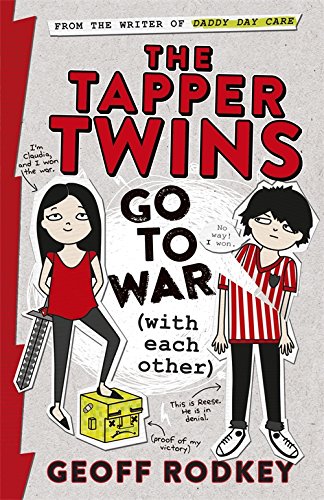
The Tapper Twins go to War (With Each Other) by Geoff Rodkey


Book review: "The Tapper Twins go to War (With Each Other)" is an account of a "war" the 12-year-old Tapper Twins, Claudia and Reese, had. The account was initiated by Claudia "so that historians of the future would know exactly what happened and whose fault it was (Reese's)."

The account is arranged as an oral history (i.e. interviews) with all the main players getting to have their say, with photos, illustrations, online chat logs and telephone text conversations being interspersed along the way. The layout being arranged into smaller chunks of text like this should appeal to younger readers.

The war itself is over little things, but also there is a conscience to it all with both parties expressing regret at what they do in their attempts at revenge. "I am NEVER going to war with anybody again."

The book is very funny with different viewpoints being expressed over the same events, and little digs that the twins have at each others' expense. All-in-all a book well worth reading.

Publication date: 2 April 2015

Amazon UK link (from £5.99): The Tapper Twins go to War (With Each Other)

Monday, 23 February 2015

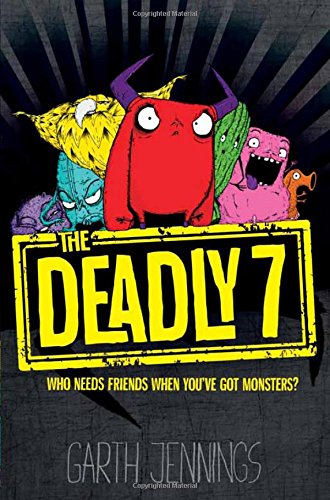
The Deadly 7 by Garth Jennings


"The Deadly 7" is a book of two halves. The first half introduces all the characters and ideas that are essential to the very fast-paced, exciting and adventurous second-half of the book.

The ideas in this book are multiple. There is the "lost chamber of St Paul's", a hidden room that main character Nelson Green finds within St Paul's Cathedral where Christopher Wren has stored many of his as-yet-undiscovered inventions, one of which Nelson accidentally ends up using when he creates the Deadly 7 - seven monsters born from his soul, "one for each of the so-called seven deadly sins". 

Then there is the River of Life - "the water is the pure source of all life"; Bang Stones - stones made from the Big Bang, "if you swallowed that stone and thought of where you wanted to be - bang - you were there," and a pendant that if "you poured all your love and hope into it could save someone's life." So the book is brimming with ideas (those mentioned and others).

Then there is the adventure element. Nelson Green is "an eleven-year-old boy with shaggy brown hair, wide chocolate-brown eyes and a single brown freckle on the tip of his nose." His sister, the "world's greatest big sister, sixteen-year-old Celeste" goes missing at the story's beginning on a school trip in Spain. Nelson's parents immediately go to Spain leaving Nelson in the care of Uncle Pogo, "a nutcase." Nelson is then roped in to finding a leak at St Paul's Cathedral by his uncle where they find the hidden chamber, and where Nelson falls on to a bed of nails that extracts the Deadly 7 from him, although he doesn't know it at first, only when they later track him down at his uncle's house.

The Deadly 7, monsters that only Nelson can see, are born from his soul so they feel his pain. "This pain... It will not go away for any of us until we find her." Thus the adventure begins with the monsters helping to locate Celeste to Brazil using their special power through "divining of the soul." However a trip to Brazil from England for an 11-year-old is anything but straightforward, even with 7 invisible monsters on your side. It is made even harder because "a very large man" with "bulging, milky eyes" is after him too.

So loads of ideas, lots of adventure and a very good story. Enjoy.

Publication date: 15 Jan 2015

Buy from Amazon UK (from £2.99 at time of writing): The Deadly 7

Wednesday, 19 November 2014

Sidney Sheldon's Chasing Tomorrow by Tilly Bagshawe


"Sidney Sheldon's Chasing Tomorrow" is the sequel to "If Tomorrow Comes". Although it is not necessary to have read the first book before this one, as the bare bones of the back story are filled in along the way, it probably is best as then you have all the detail, and know the characters from before.

This book brings back characters from the original "If Tommorrow Comes", the main two being Jeff Stevens and Tracy Whitney, "the second-most-talented and the most-talented con artists in the world." They marry and go straight, leaving behind their past lives. But that leaves a void in their lives. Jeff fills his by getting a job as curator of antiquities at the British Museum. Tracy meanwhile has the sole obsession of "trying, and failing, to have a baby", but not having the void filled leads to cracks in the marriage and then to a split, helped by an enemy who secretly couldn't stand them being together. The split ends up with Tracy disappearing into thin air.

But by the end of the book their common enemy is revealed and Jeff and Tracy are able to come together once more.

There are plenty of clever cons along the way, expertly written as Bagshawe makes you believe they are doomed to failure before the heroes successfully complete them. The story is good. This is an enjoyable read.

Publication date: 9 Oct 2014


Available on Amazon UK: Sidney Sheldon's Chasing Tomorrow

Monday, 17 March 2014

Mrs Sinclair's Suitcase by Louise Walters


This book is essentially a love story set in World War II, and the regrets unfolding from it many years down the line in 2010.

Dorothy Sinclair is the owner of the suitcase, a suitcase that has a role to play throughout the book linking the past and the modern day. She was 39 in 1940 when she met Jan Pietrykowski, the love of her life, although circumstances contrived against her, with the War being one of them of course. Fast forward to 2010 and she is 109 and has a lot to get off of her chest, and that will be to her grand-daughter Roberta who has already discovered that some of her grandmother’s (or babunia’s) backstory doesn’t match up and wants to discover why.

There are two perspectives to this story. The first is that of Dorothy, who was “a thoughtful woman, a woman of intelligence” who “just wanted Jan”. Theirs was a chance encounter, but love at first sight. 

Then there is Roberta, the grand-daughter, with the modern-day perspective, and she also has an unfulfilled love story to tell with her life always being spent at the bookshop “the Old and New, the place where I am always to be found,” hence the book spines on the front cover. She is a collector of all the letters, postcards, drawings and stuff like that that can be found in the second-hand books that come into her shop. This includes one her grandmother had, a “stupid letter which seems to refute all that my grandmother has told me about her early life.”

All in all this is a heart-warming tale of lost love, of the one who got away, and the one that didn't. 

Publication date: 27 February 2014

Amazon UK link: Mrs Sinclair's Suitcase

Tuesday, 11 March 2014

Reasons She Goes to the Woods by Deborah Kay Davies


This is no “teddy bear’s picnic.” The book is about Pearl and it paints her as a destructive, violent soul. It doesn’t matter who, whether it be her friends, her mother, her baby brother, her self, she inflicts physical pain on them all. It’s brutal and almost made me give up the book because, to me, it was so sick.

The story is told in vignettes. Each chapter is exactly one page long with one long paragraph. And between each chapter is one blank page with nothing on it apart from a chapter heading. On first impressions I thought this was clever writing to always get each chapter the same length, although my friend pointed out that it was a waste of paper.

After the brutal beginning things get a little less brutal as you follow the rest of Pearl’s childhood where things happen. Her mother is loony mad and deteriorates and Pearl gets alienated from her family and friends. The end.

At least she didn’t kill herself.

Publication date: 6 February 2014

Monday, 18 November 2013

The Merrybegot by Julie Hearn

What did people do before they had TVs? The answer is they went witch hunting. This book is set at "the height of the witch craze in England" in the 1640s. The main character is Nell and she becomes the innocent victim of one of these witch hunts, on the verge of being hanged at one point.

The story is in two parts interlinking parts. That of Nell, and the confession of Patience Madden, one of the village minister's daughters. Together they form the story of what happened.

The minister is "a right miserable bogger. A killjoy and a Puritan." So what would he do if one of her unwed daughters got pregnant? He'd cover it up and blame her daughter's period of hiding on a witch, that witch being Nell. But Nell is a merrybegot, "a child sacred to nature", thus has powers on her side to help her survive this victimisation. 

The minister enrols the help of Matthew Hopkins, the Witch-Finder General, a character who existed in real life. The other real life figure that features in the story is Charles II. However it is a fictional world with fairies and piskies featuring so any historians wanting to moan about the accuracy of their cameos should not bother.

The book does well to bring out the way it must have been felt to be the innocent victim of a witch hunt, and how powerless women and girls were when more reputable, in the eyes of society, people accused them and worked the locals up into a frenzy to nail them. 

The story does fizzle out at the end as all the loose ends are tied up after the main story arc has come to a conclusion, but overall a really enjoyable read.

(I got this book through Amazon Vine. It is listed HERE.)


Thursday, 7 November 2013

Treasure Island by Robert Louis Stevenson and read by Luke Evans


Treasure Island is a classic story. This is an abridged version of it, and lasts for 1 hour 5 minutes. I play it at night for my 6-year-old daughter as she goes to sleep. Here is her summary of her beginning of the story:

  • The person says "15 men on a dead man's chest, yo ho ho and a bottle of rum".
  • Someone comes in and wants some rum. Jim goes to get it and he sits down at the table and motions Jim to come near. Then he says, "is your table for my mate Bill?" Jim said he did not know his mate Bill, but he was the captain.
  • The captain strode in, opening the door without looking to the left or right.
  • The captain turned around with the look of a man who's seen a ghost.
  • Then the captain says "Black Dog."
  • Jim left them together and went to get some rum.
Her favourite bit of the whole story is the blind beggar part.

After a few listens she liked this, but not as much as her previous favourites from the series, Bill Nighy Reads The Wonderful Wizard of Oz and Dominic Cooper Reads Oliver Twist.


(I got this AUDIO book through Amazon Vine. It is listed HERE.)

Monday, 21 October 2013

Quantum Drop by Saci Lloyd

This is “kind of a story” that follows Anthony Griffin, a fake name so as to protect his identity, who is the boy next door.

Anthony lives in a world where you might “punch something into your deck,” or people might be “plugged into the Drop” via a visor, or you might push “a hologram chip across the table” instead of a business card.

He lives in the Debtbelt where “once your credit’s gone there’s no way back. You’re toast.” This is because of the Betta. “Short-selling, junking, gold farming, black boxing, risk-rolling – the Betta got a finger in every pie.” Basically “you’ve got to keep sweet with the Betta because they are the power.”

Except Anthony’s girlfriend didn’t keep sweet with them and has ended up dead because of them, and it is eating up at Anthony as he tries to discover what happened, all at the expense of his own future, like his exams which he walks out on. And all he’s got to go on is a voice.

So that is the story right there. And the book is Anthony’s narrative of the story. It took me a while to get into it because of his voice with all it's chattiness – “I mean, why do you think, not for even one second, do I ever, ever shut up?” – leading to diversions about brains evolving from animals etc. But the story is none-the-less gripping once it gets going. 

Older teens should enjoy.

(I got this book through Amazon Vine. It is listed HERE.)


Tuesday, 15 October 2013

Knight Crusader by Ronald Welch


“Knight Crusader” was originally published in 1954 but has been re-published due to popular demand. It is aimed at 14+ year-olds and this is because of the bloodthirstiness of it, although the book is by no means gory, and nothing that the modern child has not seen already in a video game (the original Assassin’s Creed game being set at the same time as this novel) or movie.

The book takes place at the time of the Third Crusade and features figures such as Richard the Lionheart. It follows Philip d’Aubigny on his journey from “excitable, impulsive, scatter-brained young squire” through to becoming “one of the greatest barons in Outremer,” and finally his coming to Great Britain after longing to after hearing great things of the “green country” where "the trees are everywhere, heavy with leaf, and the valleys are deep and moist."

Outremer is the Latin kingdom of Jerusalem and the Christians and the Turks are fighting for it. It is where Philip is from, being the son of a great knight Sir Hugo. Philip as a 17-year-old becomes a knight himself after proving himself in a duel. Then he is straight into proper battle as “Outremer was in deadly peril; at any moment invasion and total destruction might descend upon the Christian states.”

That battle he partakes in is the battle of Hattin and it is interesting to read the tactics involved and see how they played out during battle, plus the point when the realisation dawns on the Christians that they will lose. 

Being on the losing side Philip is taken as a slave and that ends part 1 of the book. Part 2 has his escape from Damascus and his allegiance to King Richard of England as he takes part in the successful battle of Arsuf. And Part 3 sees his coming to England to inherit the fief of Llanstephan, although he must first oust the current occupant De Braose who will not give it up without a fight.

All-all-all then a book that is interesting for its military tactics, and its historical content as it is based on real life events of the time, the author being well-versed through his career as a history teacher.  

(I got this book through Amazon Vine. It is listed for sale HERE.)

Monday, 8 July 2013

Running the Rift by Naomi Benaron


This is expert writing. There is an underlining tension throughout which keeps you on tenterhooks because the danger is ever-present.


The story is of Jean Patrick, a Rwandan runner. At the beginning it is 1984 and he is a young boy. His teacher father wishes him and his brothers and sisters goodbye before going on a journey, where he inevitably dies, in a car crash. Soon after the tensions between the Rwandan ethnic-groups, Hutu and oppressed Tutsi, of which Jean Patrick belongs, are introduced as he grows up with stones and insults being thrown his way. Other times see his big brother Roger and him having running races.

Then a marathon runner who represented Rwanda at the Olympics visits his school and Jean Patrick shows promise so that the marathon runner tells him that "one day you will need to run as much as you need to breathe". These words prove to be prophetic as the deteriorating political picture takes shape around Jean Patrick who prefers to be oblivious to it as he concentrates on his running and schooling.

And he does very well making University in 1993 where he meets Bea, meaning blessed one, who he falls in love with. In the running he gets Olympic qualifying times in the 800m, leading to the nickname "Mr. Olympics". Through his running he even gets to meet the Rwandan president Habyarimana.

But tensions are brewing all around. The media are spewing hate speech. Assassinations are happening to political leaders. Preparations are being made. "In every commune, on every level - teachers, sector leaders, burgomasters - lists of Tutsis and opposition Hutu have been collected. It's a plan for total annihilation."

Then the president is killed and the annihilation plans are quickly put in place. The UN troops flee as the international community turns its back leaving Rwanda to deal with its problems on its own. The carefully orchestrated killings of Tutsi happen. Names of people to kill are read out over the airwaves. "All Tutsi will perish. They will disappear from the earth." Jean Patrick hears about the deaths of his best friend and others over the radio, and keeps listening out for news of his family. The radio keeps the killing fever to boiling point.

Then as the Hutu Power led troops close in Jean Patrick has no choice but to run; to run through the woods and marshes full of dead bodies, past the people being killed; to run alongside the orphans and the mothers carrying their dead babies. "One day you will need to run as much as you need to breathe." That day is now.

Brilliant book that masterfully brings alive through fiction what happened in Rwanda in 1994.

(I got this book through Amazon Vine UK. It is listed HERE.)


Monday, 20 February 2012

The Psychopath Test by Jon Ronson


Excellent opening sentence: "This is a story about madness." It sums up the book immediately in just six words.

I was unfamiliar with Jon Ronson before reading this and picked up the book because it looked interesting and was in the "humour" genre. I was interested to find out how someone would make psychopaths and those with psychopathic tendencies sound funny. Unfortunately the book's classification into the humour genre was misleading as this wasn't a funny book in general. It was however fascinating to read none-the-less.

The book opens with a mystery over a cryptic book, a mystery that the author solves - the solution being a little disappointing but that wasn't his fault. This sets him off on a quest to find out more about madness, the circulation of a cryptic book being an act of madness, and being a journalist he wasn't afraid to approach the right people for their takes on the story. Nor did he take sides as he sought views from both sides. This added a balance to the narrative that could have been missing if presented by another journalist (the red-tops?).

He learnt how to identify psychopaths and starts investigating to find psychopaths at the very top of the corporate/political world as there are a greater proportion of them there than in the general population, around 3% compared with 1% supposedly. However he barely started to do this before a colleague made him doubt his psychopath-spotting abilities. So he tailed off his investigations on this which was a bit of a disappointment (but it has laid the foundations for someone else to step in and take the mantel if they are brave enough and confident enough).

Summing up this is an easy-to-read journalistic story that explores madness well although some avenues could have been explored further and no firm conclusions were made, which may be a good thing of course where classifying someone mad or allocating them with a mental disorder is concerned. Or perhaps that was the conclusion, that madness is not something that is cut and dry so keep an open mind before classing that "mad" neighbour or "mad" aunt mad.

(I received this book through Amazon Vine. It is available to buy here.)

Wednesday, 8 February 2012

Places to Hide in England, Scotland and Wales by Dixe Wills


First thing to say is that the concept for this book is brilliant. Immediately you know that’ll it’ll be a tongue in cheek type of book and indeed it is. Those who thought otherwise and expected an encyclopaedic book comprehensively listing all hiding places in England, Wales and Scotland will be disappointed. Instead you get 62 hiding places spread out across the nations, quite a lot of them on or near the coast so if you live there you’re in luck. These come with nuggets of information such as what natural foods are abundant there to eat and where is the nearest toilet. They also come with pictures. These are black and white so are sometimes difficult to see properly and would definitely have been better in colour.

Amongst all the hiding places there are other articles about hiding, like a basics guide, how to hide up a tree and how to put on a disguise. There are also articles about famous people that have gone into hiding such as Agatha Christie and Robert the Bruce and why, where and how they hid (these are inspiration for newbie hiders).

The whole book is written with humour, most of it working, the rest not working for me thanks to the usage of some obscure quotes or references or some clever language that I just didn’t get. I enjoyed this book and if I ever become a fugitive I may just take it with me.

(This book is available to buy here.) 

Saturday, 28 January 2012

The Dangerous Book for Men by Rod Green


There are a plethora of these books out there at the moment with “The Dangerous Book for Boys” probably being the book to have kick-started the trend. But which of them is better? Well I have only read this one so I can’t possibly answer that question but I can relay my thoughts about this particular book.
Basically this is a book of mini-instruction manuals. It contains many different sets of instructions detailing how to navigate using the sun, or how to survive falling out of a plane with a failed parachute and so on. It is the stuff that you’d expect Bear Grylls to know but that other men need not know. Hence this is a book that is best read by dipping in and out of it skipping the bits that you think are not relevant or that are not of interest.
The instructions are illustrated with occasional funny little drawings and diagrams to help you understand the sometimes detailed text. Also each section is normally introduced with a joke just to lighten up what would be a very dull book indeed if it were just a continued set of instructions on how to do some such “dangerous” task and then another separate “dangerous” task. And as to whether dangerous tasks include how to darn a sock or how to sew on a button or not is up to the reader to decide (after all you might get that needle stuck into your thumb, ouch).
Lastly is the advice in the book any good? Well next time I have to escape from a bear I’ll let you know. And if I am unable to let you know then you’ll know that the advice was not quite up to scratch.
(And if this review hasn’t convinced you either way as to whether to purchase this book or not then use the Amazon ‘look inside’ feature to view its contents and also to see some sample sections.)
This book is available here.