Showing posts with label Football book. Show all posts

Monday, 5 June 2017

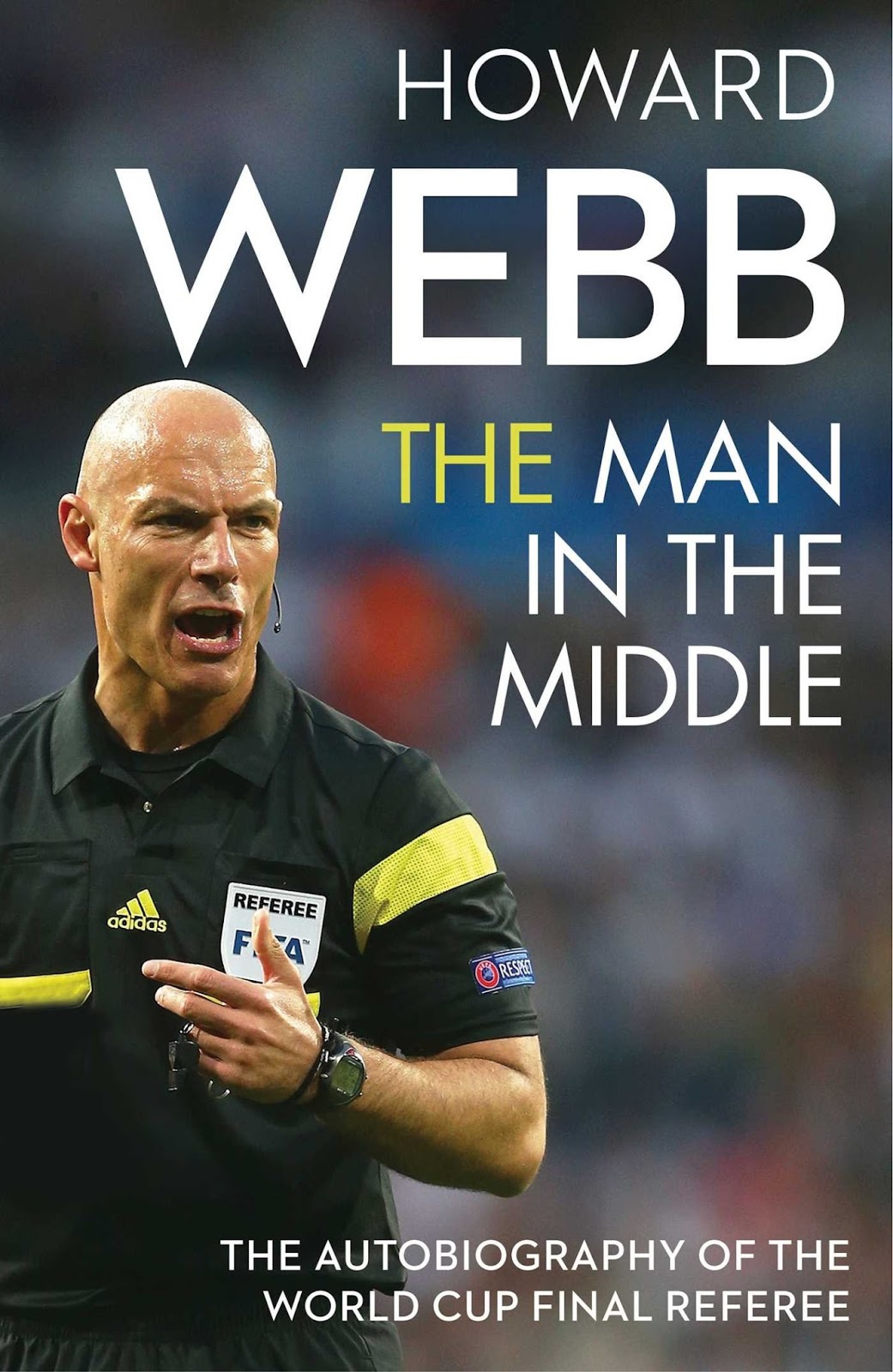
The Man in the Middle by Howard Webb #bookreview


Book Review: I gave my wife instructions for Christmas that she could buy me a football book, any football book. She bought me a book about a referee. I was not enthused. She said it was so I can see what the ref's viewpoint is. 

With lines like the following I thought it would be boring and self-indulgent:
  • "Transferring all the theory of my refereeing exams on to the pitch was tough."
  • "I soon transferred through to the Whitbread-sponsored Sheffield and Hallamshire County Senior League, before being promoted on to the assistant referees list of the semi-professional Northern Counties East League."
  • "My fellow referees line up to offer their congratulations, the likes of Viktor Kassai from Hungary, Ravshan Irmatov from Uzbekistan and Frank de Bleeckere from Belgium."

But I actually liked this. The book helps inform you as to what refs go through and how they arrive at decisions, how they feel when they have got it wrong, how they feel when they have had a good game and so on. And there are funny anecdotes too like how he struggled with CS spray in his policing days, how he graffiti-ed customers complementary diaries while working at the bank, how he swore at a player then explained it after by saying he had told the player he was a "foot off". There's an emotional moment too as he tells the tale of reffing in the Fabrice Muamba match. 

And since reading this I have taken more interest in what the ref has been doing in matches, maybe even feeling a bit more sympathy for the "man in the middle".

I would say this book is ideal for aspiring refs, but it's okay for general football fans too.

Future reviews: I will no longer be posting my book reviews on this blog. From now on they will be on Amazon UK and Goodreads only.

Wednesday, 15 March 2017

Above Head Height: A Five-a-Side Life by James Brown #bookreview


Book review: This book is "the autobiography of an amateur footballer, but it's not so much [his] story as our story." It contains tales from the author's life (related to five-a-side) but also assorted anecdotes from others (also related to five-a-side). And given the author was the founder of loaded magazine it is in the style of that. "The world of five-a-side can be as much about what happens off the pitch with your mates as on."

Originally I didn't see why he was making such a big deal over the distinction between five-a-side and normal football but the stats are presented in here (although not right at the beginning - this is not an academic paper) suggesting there is a movement from mainstream football to five-a-side. "Sport England have stated that since 2010 eleven-a-side games have been decreasing significantly, while between 2010 and 2013 alone organized leagues declined by 3,000 teams. At the same time small-sided games have been increasing significantly as the organized leagues and branded five-a-side centres have expanded into full-blown, trusted brands."

Indeed he delved into the history of five-a-side centres in the UK (with some proper journalism to go with the rest of the book) and found out that despite centres being quite commonplace now the first astroturf style centres only started appearing in the late-80s, with organized leagues starting in the 70s in sports halls. 

Other than that though the book is quite autobiographical detailing his love of football, his love of five-a-side, his detest of the rules such as above head height (because it denied him a brilliant volley of a goal but also because it causes disputes that eat up his playing time), his struggle with his fitness... But also he writes more generally how the players all delude themselves as they think they are Cruyff or whoever. And there is plenty of humour too, like his telling of an ex-coach whose catchphrase was "we're cooking with gas now" which gave the opposition plenty of laughs.

The book was also inspired somewhat by the organizer of his regular five-a-side gatherings who sadly passed away, James Kyllo. "The Sunday after he died, we gathered around the centre circle and stood for what seemed like five minutes silence."

So a decent read for football fans, with plenty to relate to.

Available on AMAZON UK HERE

Saturday, 26 November 2016

Farewell to Upton Park: The Official Celebration of West Ham's Home 1904-2016 by Andy Hooper & Lee Clayton #bookreview


Book review: When I got "Farewell to Upton Park: The Official Celebration of West Ham's Home 1904-2016" I thought it'd be a collection of iconic moments that have taken place in the stadium. The sort that Karren Brady mentions in her foreword as she talks of Hurst, Peters and Moore's first match back at the stadium after they helped England win the World Cup, how they came onto the pitch before the rest of the team to be serenaded by the fans, and the scissor-kick goal Paolo Di Canio scored versus Wimbledon. Or maybe the sort that Trevor Brooking mentioned in his opening piece entitled "The West Ham Family" when he talked about winning promotion in 1981 with players such as Alvin martin, Billy Bonds and Frank Lampard Snr.

But this book isn't that at all. Instead, it is the third introduction by Lee Clayton which best describes this book. "Over many days in that final, dramatic season... award-winning photographer Andy Hooper captured images of players, legends and supporters, iconic images of a stadium that had been 'home' since 1904." 

These photographs are spread over six chapters: The Fans, Boleyn through the ages, Our Home, Match Day, The Legends of Upton Park, and The Final Game. Of these, my favourite chapter is the shortest, the 11-page "Boleyn through the ages", where there are a handful of historic photos with interesting accompanying captions.

The rest of the book is probably best for people wanting to recapture the atmosphere of going to a match at Upton Park in 2016, or who wanted to relive the fireworks and hullabaloo of the last ever match played there.

True, the photography is of a good quality, and all very arty (see the reflection of Upton Park captured in a bubble on the cover as a case in point) but I would have liked more history to in here, especially given Upton Park was West Ham's home for 112 years.

Wednesday, 21 September 2016

Women on the Ball: A Guide to Women's Football by Sue Lopez #bookreview


Book review: Sue Lopez, author of this book, was one of the top early women footballers. She played for Southampton for many years, the team that won eight of the first eleven women's FA cups. Using her position within the game, which she continued after giving up playing with administrative and coaching roles, she tells not just her story, but also the story of women's football in England, and around the world. She also looks at "the barriers that still need to be hurdled in order for women to have real opportunities to participate." Many of these barriers are still prevalent today despite the book being 20 years old.

The first part of the book looks at the history of women's football, with the first boom peaking in 1921 with Dick Kerr's Ladies from Preston getting sell out crowds at stadiums such as Goodison Park leading to a ban by the FA on women playing on FA affiliated grounds. "The Dick Kerr Ladies had given women's football a great start, but in truth the FA ban had squashed the life out of the game." Then there was the second boom ignited by renewed interest following England winning the World Cup in 1966. This led to the Women's Football Association (WFA) being formed and organised women's football being played, and a lifting of the FA ban. The history here is really interesting especially given the author's inside view of it. There are interesting bits about the big clubs such as Manchester Corinthians and Fodens, profiles of a few high-profile England players of the time, details of the early England internationals plus details of things not documented well elsewhere like unofficial England internationals, WFA in-fighting, the WFA passing on hosting a World Cup in England etc.

And that is the first half of the book. After that the narrative stops as there is a chapter devoted to other nations women's football with lists of facts about the top nations, such as their first international match, as well as a brief description of that country's progress to date. The chapters after that are a little academic-y looking at women in different roles in football, such as a referee or a spectator, and barriers that prevail, with lots of references to other materials. 

So a book of two halves, one narrative, one more think-tank-y but worth a read.

Available on Amazon HERE.

Tuesday, 5 July 2016

Shankly's Village by Adam Powley & Robert Gillan


Book review: Glenbuck was "the village of football". A village in Ayrshire its rise and decline followed the same trajectory as the rise and decline of the British coal mining industry upon which it was built. The village, now demolished, produced a half-century of footballers. "Over a period of roughly 50 years the village produced four English FA Cup winners, five full internationals, and 50 professionals out of a population that never exceeded 1,700." "Such a rich concentration of quality has never been equalled." This book covers the village's story plus profiles of its footballers, including its most famous son Bill Shankly.

"Football and Glenbuck were an irresistible, passionate and long-lasting marriage." Football provided a release from the mines, and for some an escape altogether. Glenbuck had its own Junior League club Glenbuck Athletic latterly known as Glenbuck Cherrypickers and it is through them that many of their footballers passed through. Players such as Terrible Tait, Bogey Brown and Wee Wallace.

I think this book would be of interest of people interested in the history of Scottish coal mining in the Ayrshire area. As for the football a lot of the profiles of the players are no more than a paragraph, plus some of them never even played a first team match for their professional teams, or only played a handful of games. Also these players have been written about before in "The Cherrypickers: Glenbuck, nursery of footballers", although that was a generation ago.


Wednesday, 22 June 2016

Kicking Against Tradition: A Career in Women's Football by Wendy Owen


Book review: This book "is about how a whole new generation of girls and young women, inspired by the heroics of the England men's team in the 1966 World Cup, refused to be denied access to the people's game any longer and began literally kicking against tradition." That tradition being the infamous 1921 FA ban on women players playing on FA pitches, the ban only being reversed in 1970, and the culture at the time ("I was very aware that in wider society it was not considered to be a very suitable game for girls").

In particular the book is about Wendy Owen, a player for the very first England team. She covers her formative years, about how she liked Leeds United as a child, how she went to Craven Cottage and Wembley to see matches. Then it goes into her playing career with particular focus on her Thame Ladies and England days. This section includes a handful of scans/photos of programme covers/line-ups for big games and a letter confirming her selection for England, all very historical items now.

Then her coaching career is covered as she coached girls/women (and boys/men) in the USA, including working for Tampa Bay Rowdies in the NASL heyday, and in England ("It was great to be able to offer the kind of opportunities to female players and coaches that had not been available to me in my early career in football"). 

The rest of the book covers her assessment of the game over the years. Things like media coverage, how women's football compares across the eras and across the oceans, and what the future (to 2005 when this book was published) might hold. All from the viewpoint of "an ex-England international, coach to a university college women's football team, an FA coach educator and a senior lecturer in sport and exercise science".

The book is therefore part history of the women's game (for a period where information is scarce) and part comment on it, but for someone with an interest in the sport it will be a good read.

Amazon UK link: KICKING AGAINST TRADITION

Friday, 10 June 2016

I Lost my Heart to the Belles by Pete Davies


Book review: “They’re footballers, absolutely typical footballers – not like the untypical few who make thousands a week, but typical like the tens of thousands who play every weekend because they love it… Typical footballers. Except they’re women” 

That’s what this book is. Pete Davies has gone into a football club and followed them the whole season. Not just any football club though, this is the best in the land, the double winners of the previous season – Doncaster Belles.

What follows is a match-by-match run through of their 94-95 season with unprecedented access to the dressing room. Stirring team talks are included. The team camaraderie and banter is included. You get to follow players playing for the love of the game, not for the money. 

In between the matches the author also profiles the players in their lives away from football, at their homes, their workplaces, their social hangouts. Of course at the time of this book the top women’s players in England were all amateurs. 

And at the end of the book England’s progress at the 1995 Women’s World Cup is covered. This allows the author to discuss the state of English women’s football compared to other countries, the FA at the time only recently having taken over running the game, although not necessarily with the correct attitude. 

Of course this book is now 20 years old and these days the top women’s teams in the country have professional players and the FA is definitely more behind women playing football but it is good to look back and see where the game has come from, the struggle to get to where we are today, where there is still a massive gulf between women’s football and men’s.

Thursday, 28 April 2016

Luton Town: The Non-League Years by Rob Hadgraft

Book review: There are a plethora of books on Luton Town’s recent history. As well as this one there are no less than three others by the same author (Luton Town: Through the Trap Door: From Championship to Conference 2004-2009, Luton Town: Staring into the Abyss: Minus 30 - the Coldest Place in Football, Luton Town - the Dark Side of the Moon: Journey into the Unknown 2009-2010). And there is even a book about our first season back in the league 2014-15 (Luton Town: Back Where We Belong: A season of dream, or a lesson in reality). Maybe when the current season is over (2015-16) another book will be hitting the shelves. So perhaps the market is overheated and perhaps there are cross-overs in what each book is covering but at least as a Luton fan you can’t say you aren’t well catered for. 

I haven’t read them all so can’t make comparisons and pick out the best one, but I have read this one and can comment on it in isolation from my viewpoint of being a Luton fan and being present at many of the matches featured in this book covering out non-league years from seasons 2009-10 to 2013-14. 

There were some interesting sound bites in this book: 
  • “It was clear summer jaunts to the USA and Asia would be off Luton’s agenda for some time to come.” When were these ever on Luton’s agenda? 
  • “We were now ranked 101st in England – the lowest point in my lifetime and quite probably in the last 100 years or so” – if you’re going to say things like this maybe you could be a bit more specific 
  • A game versus Grays: “Not since Manchester United played Barnsley in the Premier League had there been a bigger gulf between two clubs in the same division” Nice sound bite but hard to prove. 
  • On Jason Walker and his famous Panenka penalty v AFC Wimbledon: “it was high-risk and only attempted by the supremely skilful, supremely confident…. Even Peter Crouch had come a cropper.” Yes even the supremely skilful Peter Crouch. 
  • “Loanee Jake Robinson debuted but made little impact at the Impact Arena” Don’t know how this made it into the book given the player in question went on to play just 7 Conference games in total for Luton making “little impact” before leaving, perhaps it is for the wordplay.  
  • On a 5-0 win over Kettering: “the most one-sided league match ever seen at Kenilworth Road” – even more so than our 12-0 against Bristol Rovers in 1936 which I presume the author was at so as to offer his opinion? 
  • “as the great French poet Rimbaud wrote…” – sorry, you lost me. 
  • On Luton’s away following at Welling “a massive 75 per cent of the 2,650 were away supporters. Surely some sort of record?” Er, no because on the next away game at Hyde the author writes: “a crowd that was more than 80 per cent Luton fans” 

There are some depressing bits too as the writer talks about all the booing and abuse that Luton got during this time: 

  • “Despite being unbeaten after five games, Luton had been booed off by their own fans three games in a row.” 
  • After his third league game in charge, a 0-0, Richard Money said “I have never before been subjected to the abuse I received at Chester. I remember walking off the pitch thinking – wow, what is going on here?” 
  • After 10 games played in 2011-12: “We went top for the first time in more than a year, yet players, fans and management all headed home dissatisfied.” 

Even the author gets stuck into the team: 

  • “We had no divine right to beat clubs of the stature of Braintree and Dartford, of course, but losing to part-timers is an embarrassment all the same, especially for the long-standing supporters like this writer” 

But then there are better moments, like when the author brings out of the quaintness of following a football team in the non-league after being in the League for so long: 

  • On Forest Green away – “We parked at the local primary school in an area that looked as if Compo and Clegg from Last in the Summer Wine would go cycling by at any moment.” 
  • On Histon's ground: “this exposed meadow in the Fens” 
  • On Welling away: “there was a friendly atmosphere here that made it feel rather like a Saturday afternoon church fete.” 

And then there are the shared good on-field memories where the author covers things such as the emergence of Andre Gray (now Championship player of the year and surely destined for the Premier League shortly), the purple patch we had towards the end of 2009-10 when Gnakpa ate his soup and the team smashed in the goals, and of course the promotion winning season. 

So a depressing read in places and a more uplifting read in others.

Friday, 8 January 2016

Non-League Supporters' Guide & Yearbook 2016 by John Robinson


Book review: I use this book as a quick reference guide for info on the 68 National League clubs. These are the most interesting pages in the book. The other pages contain fixtures for the season, and the results for the previous season including all FA Vase and FA Trophy results.

There are some good things about this book:
  • It is lightweight so can be carried around easily if you are travelling to the stadiums for matches.
  • It was interesting to look at the pictures of the stadiums of the National League clubs and see how small some looked and how big others looked.
  • The back cover lists the other books Soccer Books publish and some of those look interesting.

But I had some disappointments too:
  • Only National League clubs are profiled, so not all non-league clubs are covered, although the small-print on the cover does hint at this.
  • For some teams the record attendance statistic only shows a figure with a date, yet no opponent, e.g. Nuneaton Town: 3,111 (2nd May 2009). I'd like to know the opponent and for some teams this info is given, which is inconsistent.
  • The record attendance given for Nuneaton Town above is wrong, it is actually 3,480 v Luton Town on Feb 22nd 2014. This is easily found out online so I am surprised that this hasn't been updated, especially considering this book has annual updates.
  • Other inconsistencies I found in the book include the founded date given for clubs. For Nuneaton Town their founded date is given as "1937 (Reformed 2008)" but this overlooks the fact that the 1937 club was itself reformed from an earlier Nuneaton formed in 1889. And if you include reformed dates why are AFC Telford United given a founded date as 2004 when they are a reformed club too?

Back cover
So you can see I found data inconsistencies and inaccuracies without even having to delve too deeply. Hopefully the other info in the book is correct, especially the travelling info, otherwise fans might end up in the wrong place, just like my mate and I when he set his Sat Nav to take us to MK Dons and we ended up at the National Hockey stadium although they had moved to stadium:MK by then. We were late for that match.

Other things I would have liked - colour pics instead of black and white ones and full stadium pics (maybe aerial, or panoramic) rather than just of one stand like most of these are. As it is the contents in this book can be found on the internet, with the internet contained more information, which is probably more accurate and more up-to-date too (e.g. for re-arranged fixtures). So use the internet is my advice.

Publication date: 5 August 2015

Tuesday, 1 December 2015

Articles of Faith by Russell Brand


Book review: “Articles of Faith” is a book by Russell Brand about football. Don’t be getting it though if you want a companion to his Booky Wook books or his DVD shows unless you like football.

Basically the book is a “collection of columns” that Brand wrote for the Guardian newspaper during the 2007-08 season. There is a smidgeon of added value with some extras that you wouldn’t have originally got with your newspaper, these mainly being the cover “in which I am inadvisedly posing as Christ”, and three interviews with famous football fans – a humorous discussion of the football songs “Three Lions” and “I’m Forever Blowing Bubbles” with David Baddiel, a rushed interview with James Corden about West Ham, and a chat about Manchester City becoming the richest club in the world with Noel Gallagher.

The “rattishly indulged” articles “focus chiefly on Brand’s reaction to the phenomena of football culture” rather than focusing on the football itself, and are done in the Russell Brand style with plenty of poetic and fruity language, lots of analogies, e.g. “like a knicker thief suddenly made manager of a laundrette”, and many a “wacky, sideways” view, e.g. “I enjoyed his scissor-kick somersault celebration although I’d be the first to condemn him if he did it in a refuge for battered women.”

The presentation is lavish with colour illustrations relating to the text throughout, such as one of “former Blades boss Neil Warnock poised in a circle of stone, stinking of chicken’s blood, spewing white-eyed incantations and clutching a buckled dolly of West Ham player Julien Faubert”, but never actual photos of any of the football or footballers, the only photos being promo shots of Brand, pencil in hand (for example).

As for the football this was the season when Steve McClaren’s England “smashed to bits” the “beautiful distraction of Euro 2008”, and where “poor unlovable Avram’s” Chelsea and Manchester United contested the Champions League final. As there is no context presented between articles a basic knowledge of what went on in the football world at this time, as well as the characters, is advisable.

Overall then what you have here is a funny, episodic read about the 2007-08 English football season, with a slight West Ham bias (Brand being a West Ham supporter). His last words are “Football does not make sense” so ultimately this book probably doesn’t make sense, but I thought it was a good read anyway.

Published: 15 Oct 2008

Thursday, 19 November 2015

All Played Out by Pete Davies


Book review: “All Played Out” is the tale of Italia ’90, with a focus on England’s time there. It is interesting reading it now as in many ways despite not being that long ago it seems a different era. This was a time when the Premier League hadn’t begun, when Lineker had scored only thirty-odd goals for England, and when it was still just 2-points for a win. Also “these were the horror days of a nation all played out, a nation of riot and yobbery, a nation whose football was oafish and whose fans were louts.” Hooligans are far less an issue these days of course.

Along the way as the author follows England there is a lot of talk of the “fans” and the thuggish behaviour of a minority, always written about in the English press in an over-exaggerated manner, and the thuggish behaviour of the Italians too, plus their baton-wielding police. There is also a lot of talk about the English press, “the worst disciplined press in Western Europe”, because the author of the book was a fully signed-up member of the press pack with all the privileged access that brings, this access allowing him to conduct several interviews in the book with members of England’s playing squad, as well as the manager.

Some of these interviews are interesting retrospectively now, like how Lineker would “like to go into television”, and how Waddle thought Gazza with his personality could be a danger to himself when he was older. Also retrospectively it looks odd why Bobby Robson got so many negative headlines as England manager with his impressive record of a world cup quarter-final followed by a semi-final, but when the author maligns the press behaviour through much of the book you can probably begin to see why that happened.

The book also delves into football more technically than other offerings, with lots in particular on systems with 4-4-2 being said to be “all played out”. The author also covers all the wider football stuff going on at the World Cup in “Planet Football” with England players performing commercial activities such as casually modelling clothes or delivering Malaysian sound-bites, and some remarks on the official cheese of Italia ’90 with a multitude of tall, beautiful cheesewomen being present at various press events, never failing to impress the author, although the cheese less so as he never talks about tasting it.

The book covers more than just football though. For example it starts before the World Cup with a journey to Sardinia and Cagliari, England’s World Cup base for their group games, and delves into the history and culture of the place. Some of this works better than other bits, for example all the administration bits about waiting for fax machines to work etc. as he tries to obtain press tickets and the like could have been left out.

There is also a good writing style present too. On the unpredictable Gazza getting fouled: “Will he clout the guy? Or will he get up and shake his hand, pat his face and ruffle his hair, then embrace the referee?” And on the stadiums: “where the ordinary folk go to watch the men who’ve got gold in their shoes.”

Overall then an enjoyable read, and if you want to play a game whilst reading then see if you predict when the author is just about to use his favourite phrases “all played out” and “Planet Football”.

Published: 29 Oct 1990